

Highlights: Browser Config is Here!
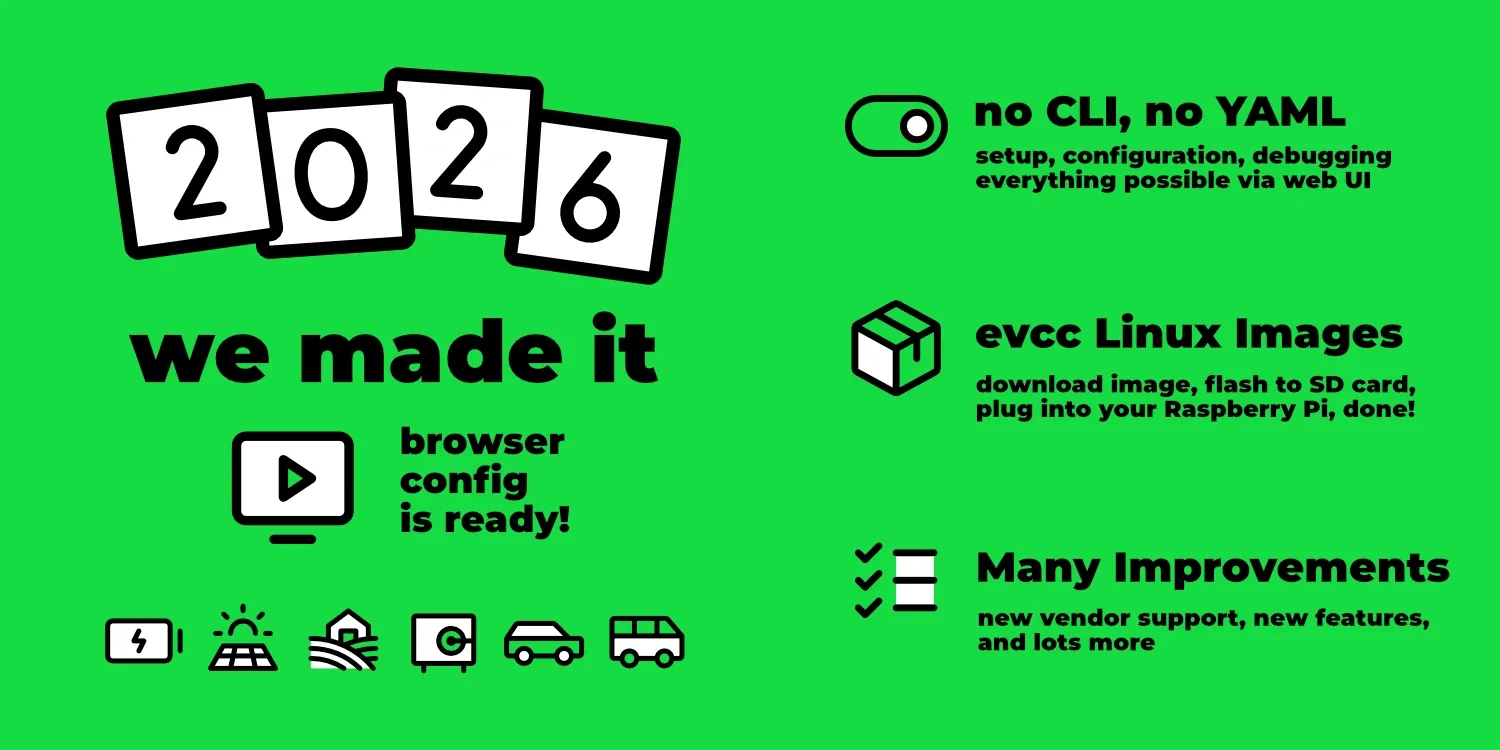
2026 is here and with evcc v0.300, the new year starts with probably the most important milestone: Browser-based configuration is no longer experimental. The most requested feature is finally ready for production use. New users can now set up evcc completely without command line or YAML files.
In this article, we look at the highlights since July 2025 and provide an outlook for the coming year.
Browser-Based Configuration

Section titled “Browser-Based Configuration”Initial setup via command line and editing YAML files has long been the biggest hurdle for new users. We’ve been working for several years to simplify this process. With v0.300, the time has come: Browser-based configuration via web UI is now officially released and the recommended way for new users.
What’s New?
Section titled “What’s New?”Since the last highlights article, we’ve added and improved many features:
- Bug Reporting Directly in Web UI: Diagnostic information can now be exported for GitHub issues directly through the interface.
- OCPP Setup: The setup process for OCPP wallboxes has been significantly simplified.
- Modbus Proxy UI: Comfortable interface for Modbus proxy configuration.
- OAuth Authentication: UI-based authorisation flow for BMW, Mini, Viessmann, Home Assistant, Volvo and other services.
- Dynamic Suggestions: Smart suggestion values simplify configuration. Used e.g. for sensors and switches in Home Assistant. Coming soon for Modbus settings and network devices.
- Many additional bugfixes and improvements.
What’s Still Missing?
Section titled “What’s Still Missing?”All functions can be configured via the UI. However, YAML syntax is still required in some places.
- Tariffs and forecasts
- Load management and HEMS configuration
- Notifications (work in progress)
We’ll be addressing these in the coming months.
For Existing Users
Section titled “For Existing Users”Already using evcc with an evcc.yaml?
Then you don’t need to change anything.
The evcc.yaml continues to be supported.
If you want to switch to the web UI, you can use both configuration methods in parallel and migrate gradually.
Devices from the evcc.yaml are visible in the UI but not editable.
More details about the migration process can be found in the FAQ.
evcc Linux Images
Section titled “evcc Linux Images”Along with the stable web UI, there’s another important new feature: Ready-to-use Linux Images for Raspberry Pi and other systems.
Installation is now possible without much technical knowledge:
- Download image
- Flash to SD card
- Insert into Raspberry Pi
- Start setup directly in the browser
Completely without command line or YAML files.
Besides all Raspberry Pi versions, the NanoPi R3S is also supported. The images are based on Armbian, making it easy to add new single board computer platforms.
More details can be found in the installation guide and in the GitHub repository.
More Highlights
Section titled “More Highlights”Besides the web UI, there have been many other new features in recent months:
Tariffs: 15-Minute Price Forecasts
Section titled “Tariffs: 15-Minute Price Forecasts”The EPEX exchange price for electricity has been provided in 15-minute intervals instead of hourly since October 2025. evcc now consistently uses quarter-hour slots internally. Planning algorithm and visualisation have been adapted. Many tariffs and solar forecasts have already been switched to the shorter interval.
Planner: Continuous Charging

Section titled “Planner: Continuous Charging”The charging planner has received a new option. You can now choose between continuous and cheapest. Continuous planning selects the best contiguous charging window to avoid frequent interruptions.
Integration: Home Assistant
Section titled “Integration: Home Assistant”We had contact with the Home Assistant team and are working on better integration of both projects. First results are already visible. You can set up vehicles, chargers and metres based on Home Assistant sensors and switches. We use Home Assistant’s autodiscovery and OAuth mechanism for this. The matching Home Assistant entities are suggested to you in the edit screen.
Loadpoints: Sort & Hide

Section titled “Loadpoints: Sort & Hide”Loadpoints can now be sorted and hidden in the UI. Settings are saved per browser and enable individual views for different users.
Sponsoring: New Prices
Section titled “Sponsoring: New Prices”We love open source and are convinced that the open knowledge accumulated in the project is a huge boost for the energy transition.
Software development thrives through you - the community: wishes, ideas, testing and active code contributions drive the direction of the project. However, operation and focus require a lot of time. The project has grown so much that it’s long been more than a small side project for us. Therefore, financial support is important to continue developing and maintaining evcc sustainably in the long term.
After almost 5 years, we’ve now decided to adjust sponsor prices for the first time.
New Prices from 2026
Section titled “New Prices from 2026”- Monthly Sponsoring: from $4 (previously $2)
- One-time Sponsoring: from $150 (previously $100)
Why This Adjustment?
Section titled “Why This Adjustment?”A lot has changed in the last 5 years:
Dollar Exchange Rate and Inflation: The dollar exchange rate (GitHub Sponsoring) has fallen and inflation has also increased our real costs.
Feature Scope: evcc has evolved enormously. Features like the web UI, Linux images, smart charge planning, heat pump control, solar forecasts and many other functions have been added. What started in 2020 as a pure solar surplus tool is today a comprehensive energy management platform.
Sustainability: We still have a lot planned (see 2026 outlook below). To continue developing evcc long-term and maintain quality, a solid financial foundation is needed.
Already Sponsoring?
Section titled “Already Sponsoring?”Nothing changes for existing sponsors:
- One-time sponsorships (made before 2026) naturally remain in place
- Monthly sponsorships continue without price increase – you continue paying the previous price
- Voluntary increases are of course welcome, but not required
🙌 Thanks to everyone who has supported evcc over the years – without you, the project wouldn’t be where it is today.
More details can be found in the sponsorship documentation.
New Device Support
Section titled “New Device Support”44 new manufacturers have been added since July 2025. The evcc device library now includes over 240 manufacturers and more than 620 products.
Wallboxes: Alpitronic, EV Expert, FoxESS, Neoom, Sigenergy, V2C, Veton
Heat Pumps & Heating Elements: LG, NIBE
Metres: Aandewiel, B+GE-TECH, Cozify HAN, DDM, EcoFlow, Home Assistant, Lovato, Senergy, Sermatec, Solakon, Strong Energy, Zendure, amsleser.no
Solar/Battery Systems: ABB, B+GE-TECH, Bernecker Engineering, DDM, DZG, EcoFlow, Home Assistant, Lovato, ORNO, Saia-Burgess Controls (SBC), Schneider Electric, Sermatec, Solakon, Strong Energy, Wago, Weidmüller, amsleser.no, inepro
Vehicles: Ford Connect, Home Assistant, Hyundai (US), Subaru
Of course, many bugfixes and improvements have also been made to existing implementations. Details can be found in the release notes.
2026 Outlook
Section titled “2026 Outlook”With the stable web UI, a major milestone has been reached. The work on it has taken a lot of time. We’re happy to now be able to focus more on new features again. The coming year will be exciting – here’s an outlook on the planned priorities:
Optimisation Algorithm
Section titled “Optimisation Algorithm”Today, we often control individual components separately. The optimiser aims to optimise the entire system: parallel charging of multiple vehicles, home batteries and consumers – based on price signals, solar forecasts and household consumption predictions.
Since mid-2025, a group of people has been working on an optimisation algorithm for evcc. It’s based on systems of equations and statistics. Product marketing would probably call it AI 😉. The optimiser can already be integrated in read-only mode today and its results can be displayed with special configuration.
The next steps:
- Visualisation: Display insights from the optimiser in the evcc interface where it makes sense
- Active Control: Control planner, grid charging and other functions based on optimiser data
More on this in the GitHub issue.
Better Display for Consumers and Heaters
Section titled “Better Display for Consumers and Heaters”The display and control of regular consumers (washing machine, dryer, …) and heaters should be improved.
Today, these can already be added as “Heating” or “Additional Meters” and displayed in the energy flow diagram. A display as separate tiles is planned, as well as recording time-based data. The “mini loadpoints” concept has existed for some time – most of the building blocks are now in place. We’re working on this in the coming year and look forward to more clarity and specific functions for these devices.
Details can be found in the GitHub discussion.
Time-Based Statistics
Section titled “Time-Based Statistics”Currently, we only capture statistics based on charging sessions. Additionally, we plan to collect purely time-based data for consumption, generation, heat generation and other metrics. This long-requested feature enables overview statistics like those familiar from many manufacturer apps - but for all devices in your home. Questions like “How much solar power did the heat pump use?” or “How much energy did my solar systems produce today?” should be answerable with this. The display will complement the existing charging-optimised view.
💚 Big thank you to everyone who has brought the project this far – through collaboration, discussion, ideas, testing and especially financial support.
We wish you a good start to 2026 and are happy that the days are getting longer again.
Best regards
The evcc Team
Michael, Andi & Uli